Presbyterian Bible Study
Study Scripture in the Reformed tradition - where God's sovereignty is supreme, covenants reveal His redemptive plan, and the whole of life is lived "Soli Deo Gloria" (to God alone be the glory). Experience Bible study tools shaped by the Westminster Standards, covenant theology, and the rich heritage of Presbyterian churches that have treasured careful, theological engagement with God's Word for over 500 years.
Key Takeaways: Presbyterian Bible Study
God's Sovereignty - The Lord reigns over all creation, history, and salvation
Covenant Theology - God relates to His people through unfolding covenants in Scripture
Westminster Standards - Catechisms and Confession provide a framework for interpretation
Five Solas - Scripture, Grace, Faith, Christ, and God's Glory alone
Ordered Polity - Elder-led governance reflects biblical church leadership
Doctrines of Grace - TULIP summarizes Reformed understanding of salvation
In 1559, John Calvin published the final edition of his monumental "Institutes of the Christian Religion," providing the theological foundation for what would become Reformed Christianity. That same decade, John Knox brought Reformed theology to Scotland, establishing Presbyterianism as a distinct tradition that would shape nations, universities, and millions of believers across centuries and continents.
At the heart of Presbyterian Bible study lies a profound conviction: that God is absolutely sovereign over all things, and that His Word reveals the unfolding story of redemption through covenants - from Adam through Noah, Abraham, Moses, and David, culminating in the New Covenant in Christ. This theological framework transforms how Presbyterians read every passage of Scripture, seeing connections between Old and New Testaments and recognizing God's single plan of salvation running throughout.
Today, approximately 75 million Christians worldwide belong to churches in the Reformed and Presbyterian tradition. From the Presbyterian Church (U.S.A.) to the Presbyterian Church in America (PCA), from the Orthodox Presbyterian Church (OPC) to Reformed churches across Europe, Africa, and Asia, the heritage of Calvin and Knox continues to shape how millions approach daily Bible study and theological reflection.
The Presbyterian Story: From Geneva to the World
John Calvin (1509-1564) was a French theologian and reformer whose systematic mind gave shape to Reformed theology. After his conversion, Calvin settled in Geneva, Switzerland, where he established a model Christian community that became the "Protestant Rome" - a center from which Reformed missionaries, refugees, and ideas spread throughout Europe and eventually the world.
Calvin's theology emphasized God's absolute sovereignty over creation and salvation. Against those who stressed human free will in coming to faith, Calvin insisted that fallen humanity is so deeply corrupted by sin that no one can choose God unless God first chooses them. Election, predestination, and irresistible grace became hallmarks of Reformed theology - all flowing from the conviction that salvation belongs entirely to the Lord.
"Man's mind is like a store of idolatry and superstition," Calvin wrote, "so much so that if a man believes his own mind it is certain that he will forsake God and forge some idol in his own brain." This assessment of human nature - total depravity - shapes how Reformed Christians read Scripture: with humility, dependence on the Holy Spirit, and submission to God's revealed Word rather than human speculation.
John Knox (c. 1514-1572) brought Reformed theology to Scotland after studying with Calvin in Geneva. His fiery preaching and organizational genius established the Church of Scotland as Presbyterian in polity - governed not by bishops but by presbyteries (assemblies of elders). Knox's Book of Discipline and the Scots Confession laid the foundation for Presbyterian churches worldwide.
The Westminster Assembly (1643-1653) produced the Westminster Confession of Faith, Larger Catechism, and Shorter Catechism - documents that remain authoritative in most Presbyterian churches today. These comprehensive standards provide a systematic framework for understanding Scripture, including the famous answer to the Shorter Catechism's first question: "Man's chief end is to glorify God and enjoy Him forever." This shapes how Presbyterians approach Scripture study.
The Five Solas: Reformed Foundations for Bible Study
Presbyterian and Reformed theology is often summarized in the "Five Solas" - five Latin phrases that emerged from the Reformation and continue to shape how Reformed Christians read and interpret Scripture.
1. Sola Scriptura: Scripture Alone
The Bible alone is the inspired, infallible Word of God and the only ultimate authority for faith and practice. While Presbyterians value the Westminster Standards and historical theology, these are authoritative only insofar as they faithfully summarize Scripture. The Confession itself states: "The Supreme Judge, by which all controversies of religion are to be determined... can be no other but the Holy Spirit speaking in the Scripture."
2. Sola Gratia: Grace Alone
Salvation is entirely God's gift, not earned or merited by human effort. Reformed theology emphasizes that even the faith by which we believe is itself a gift of grace. We contribute nothing to our salvation - God does it all. This shapes Bible study by directing attention always to God's work rather than human achievement. Like Lutheran Bible study, Presbyterians emphasize grace, though with distinctive Reformed emphases.
3. Sola Fide: Faith Alone
Justification - being declared righteous before God - comes through faith alone, not through works, sacraments, or rituals. Good works are the fruit and evidence of genuine faith, not its cause. Faith itself is the gift of God, given to the elect through the Spirit's work.
4. Solus Christus: Christ Alone
Jesus Christ is the only mediator between God and humanity. There is no other name under heaven by which we must be saved (Acts 4:12). Presbyterian Bible study is always Christ- centered, seeing all of Scripture as pointing to Jesus - even Old Testament passages find their fulfillment in Him.
5. Soli Deo Gloria: To God Alone Be the Glory
Everything exists for God's glory, and all glory in salvation belongs to Him alone. This is the overarching principle: God saves sinners to display His glory. It's why the Shorter Catechism begins with glorifying God as humanity's chief end. Understanding worship in Scripture flows from this foundation.
"Man's chief end is to glorify God, and to enjoy Him forever."
- Westminster Shorter Catechism, Question 1
Covenant Theology: The Presbyterian Framework
One of the most distinctive features of Presbyterian Bible interpretation is covenant theology - the conviction that God relates to humanity through covenants and that these covenants provide the structure for understanding all of Scripture.
The Covenant of Works
Before the Fall, God established a covenant with Adam as representative head of humanity. Perfect obedience would bring eternal life; disobedience would bring death. Adam failed, and in him all humanity fell. This explains why even newborn infants are considered sinful - Adam's guilt is imputed to all his descendants. The covenant of works establishes humanity's problem: we are guilty before God through Adam and unable to save ourselves.
The Covenant of Grace
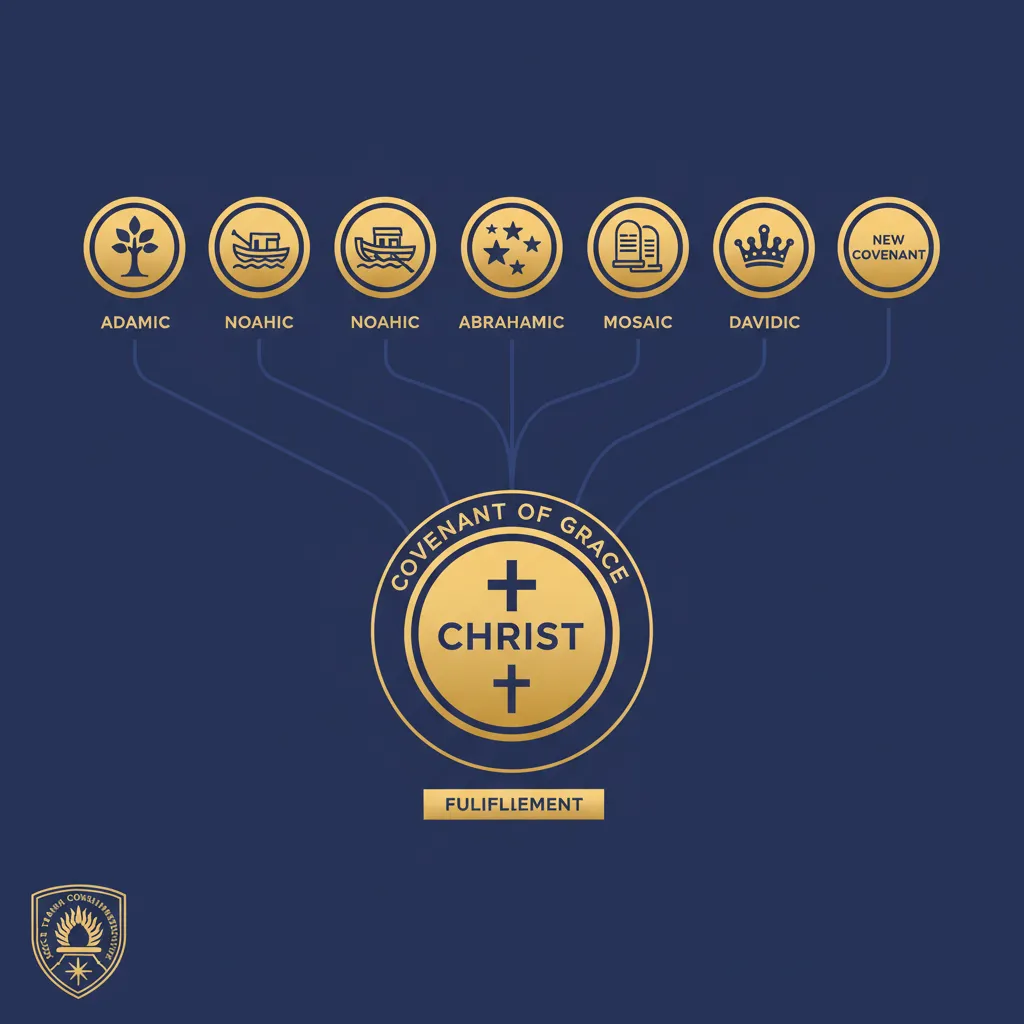
After the Fall, God established a covenant of grace in which He would save sinners through the work of Christ, the "second Adam" and "last Adam" (Romans 5:12-21; 1 Corinthians 15:22,45). This single covenant of grace unfolds progressively through biblical history: in promises to Adam and Eve, Noah, Abraham, Moses, and David - all pointing forward to Christ who fulfills every covenant promise.
Unity of the Bible
Covenant theology sees essential continuity between Old and New Testaments. The church is not a new institution but the continuation of God's covenant people Israel, now expanded to include Gentiles. This is why Presbyterians baptize infants - children of believers are covenant members, just as children of Israelites received circumcision. The sign has changed, but the covenant continues.
This differs from dispensational approaches (common in some Baptist churches) that see sharper discontinuity between Israel and the church. For Presbyterians, covenant theology provides the unifying lens through which all Scripture is read - connecting Old Testament study to New Testament fulfillment.
TULIP: The Doctrines of Grace
The "Doctrines of Grace" - often remembered by the acronym TULIP - summarize the Reformed understanding of salvation. These five points were formulated at the Synod of Dort (1618-1619) in response to Arminian challenges but represent beliefs held by Reformed Christians since the Reformation.
T - Total Depravity
Every part of human nature is corrupted by sin. This doesn't mean people are as bad as possible, but that sin affects every aspect - mind, will, emotions. Consequently, no one can choose God or contribute to their salvation apart from God's grace. We are spiritually dead (Ephesians 2:1), not merely sick.
U - Unconditional Election
God chose those who would be saved before the foundation of the world, not based on foreseen faith or merit but solely according to His sovereign will and pleasure (Ephesians 1:4-5). Election is unconditional - nothing in us caused God to choose us; His choice was based entirely on His grace.
L - Limited Atonement (or Particular Redemption)
Christ's death on the cross actually accomplished salvation for the elect, not merely made salvation possible for everyone. Jesus died as substitute for His people specifically. The atonement is limited not in power or value but in intent - it was designed to save those God had chosen.
I - Irresistible Grace (or Effectual Calling)
When God calls the elect to salvation, that call is effectual - it accomplishes its purpose. The Holy Spirit regenerates the heart, enabling and causing the sinner to believe. This doesn't mean people are forced against their will but that God changes their will so they freely and gladly come to Christ.
P - Perseverance of the Saints
Those whom God has truly saved will persevere in faith to the end. They may fall into sin temporarily, but they will never finally fall away. God preserves His people - "those whom He justified He also glorified" (Romans 8:30). This shapes how Presbyterians understand salvation passages throughout Scripture.
How Presbyterian Bible Study Works in Practice
The Westminster Standards
Presbyterian churches typically subscribe to the Westminster Confession of Faith (1646) and the Larger and Shorter Catechisms. These documents provide a comprehensive theological framework drawn from Scripture. The Shorter Catechism, with its 107 questions and answers, is commonly used for instruction. The Larger Catechism goes deeper into doctrine, while the Confession addresses major theological topics systematically.
Scripture Interprets Scripture
The Westminster Confession teaches that "the infallible rule of interpretation of Scripture is the Scripture itself." Clearer passages illuminate difficult ones. When studying any text, Presbyterians compare it with other relevant passages, letting the whole counsel of God inform understanding of each part.
Christ-Centered Reading
Presbyterian Bible study sees Christ throughout Scripture. Jesus Himself said, "These are the Scriptures that testify about me" (John 5:39) and "Beginning with Moses and all the Prophets, he explained to them what was said in all the Scriptures concerning himself" (Luke 24:27). Every passage, including Psalms study, points to Christ in some way.
Careful, Theological Approach
Presbyterian tradition values careful, thoughtful engagement with Scripture. This includes:
- Studying the original languages (Greek and Hebrew) or consulting scholarly resources
- Understanding historical and literary context
- Applying systematic theology to interpretation
- Consulting Reformed commentaries and theological works
- Discussion and accountability within the church community
Popular Presbyterian Bible Study Resources
Study Bibles
- Reformation Study Bible (ESV) - R.C. Sproul's comprehensive Reformed study Bible with confessional notes
- ESV Study Bible - Widely used with Reformed contributors and theological depth
- Spirit of the Reformation Study Bible (NIV) - Notes from Reformed perspective
- NIV Zondervan Study Bible - D.A. Carson's scholarly study Bible
Bible Translations
Presbyterians use various translations, though some are more common:
- English Standard Version (ESV) - Preferred by many Reformed churches for accuracy
- New International Version (NIV) - Popular for accessibility
- New American Standard Bible (NASB) - Valued for literal accuracy
- King James Version (KJV) - Traditional choice for some
- New Revised Standard Version (NRSV) - Used in PCUSA churches
Reformed Curriculum and Programs
- Ligonier Ministries - R.C. Sproul's teaching ministry with extensive Bible study resources
- Great Commission Publications - Curriculum for PCA and OPC churches
- Westminster Bookstore - Resources from Westminster Theological Seminary
- Banner of Truth - Classic Reformed and Puritan works
- Horizons Bible Study - Women's Bible study for PCUSA
Presbyterian Bible Study Community
Rooted in Reformed theology, devoted to Scripture
What We Offer
- Covenant theology framework
- Westminster Standards integration
- Christ-centered interpretation
- Sovereignty-focused study tools
"As a PCA elder's wife, I've found Bible Way helps our women's Bible study dig deeper into covenant theology while remaining accessible. The app supports our Reformed commitment to serious Scripture engagement."
Sarah M.
PCA Church, Georgia
Frequently Asked Questions
Real questions about Presbyterian Bible study
What is covenant theology and why is it important for Bible study?
Covenant theology is the framework that sees God relating to humanity through covenants - formal agreements with promises and conditions. The two main covenants are the covenant of works (with Adam before the Fall) and the covenant of grace (God's promise to save sinners through Christ). This covenant of grace unfolds progressively through biblical history: promises to Adam, Noah, Abraham, Moses, David, and the New Covenant in Christ. Covenant theology sees essential continuity between Old and New Testaments - one people of God, one plan of salvation, fulfilled in Jesus. This shapes how Presbyterians read every passage, looking for covenant themes and connections to Christ.
What are the Westminster Standards and how do Presbyterians use them?
The Westminster Standards include the Westminster Confession of Faith (WCF), the Larger Catechism (WLC), and the Shorter Catechism (WSC), produced by the Westminster Assembly in the 1640s. These documents systematically summarize biblical doctrine and remain authoritative in most Presbyterian churches. Officers typically vow to uphold them as faithful summaries of Scripture. The Shorter Catechism's 107 Q&As are commonly used for instruction. The Standards aren't equal to Scripture - they're authoritative because they accurately explain Scripture. When studying the Bible, Presbyterians may consult the Standards to see how their tradition has understood particular doctrines.
What does TULIP mean in Reformed theology?
TULIP is an acronym summarizing the "Doctrines of Grace" - the Reformed understanding of salvation: Total Depravity (all humans are completely corrupted by sin and cannot save themselves); Unconditional Election (God chose the elect before creation, not based on foreseen faith); Limited Atonement (Christ died specifically to save the elect, actually accomplishing their salvation); Irresistible Grace (when God calls the elect, they will come - He changes their hearts so they freely believe); Perseverance of the Saints (those truly saved will never finally fall away). These points were formulated at the Synod of Dort (1618-1619) against Arminian teaching and shape how Reformed Christians interpret salvation passages.
What Bible translation do Presbyterians typically use?
Presbyterian churches use various translations. The English Standard Version (ESV) is increasingly common in conservative Presbyterian churches like the PCA and OPC, valued for its accuracy and literary quality. The NIV remains popular for accessibility. The New Revised Standard Version (NRSV) is common in PCUSA congregations. Some traditional churches still use the King James Version (KJV). The NASB is respected for literal accuracy. Many Presbyterian scholars also work with original languages. The key principle is fidelity to the original Hebrew and Greek - any accurate translation can be used for study.
How is Presbyterian theology different from Baptist theology?
Key differences include: Covenant vs. Dispensational - Presbyterians typically hold covenant theology seeing continuity between Israel and the church; many Baptists hold dispensationalism with sharper discontinuity. Infant Baptism - Presbyterians baptize infants of believers as covenant members (like circumcision in the Old Testament); Baptists baptize only professing believers. Church Government - Presbyterians have elder rule with connectionalism (presbyteries, general assemblies); most Baptists have congregational independence. Lord's Supper - Presbyterians typically hold spiritual presence; many Baptists hold memorial view. Soteriology - Most Presbyterians hold Reformed TULIP; Baptists range from Calvinist to Arminian. These affect how each tradition reads and applies many biblical passages.
Why do Presbyterians baptize infants?
Presbyterians baptize infants based on covenant theology. In the Old Testament, children of believers received the covenant sign (circumcision) and were considered part of God's covenant people. Presbyterians believe the New Covenant continues this pattern - children of believers are covenant members who should receive the covenant sign (now baptism). Acts 2:39 says the promise is "for you and your children." Household baptisms in Acts suggest inclusion of children. Baptism doesn't save - it's a sign and seal of God's covenant promises. The baptized child is raised in the faith, and if they later profess personal faith, they're received into communicant membership. This differs from Baptist "believer's baptism" which requires personal profession first.
What is the role of elders in Presbyterian church government?
"Presbyterian" comes from the Greek presbyteros (elder). Presbyterian churches are governed by elders, not by bishops (episcopal) or congregational vote alone. There are two kinds: Teaching Elders (ministers/pastors who preach and administer sacraments) and Ruling Elders (lay leaders who help govern). Elders form a "Session" that governs the local church. Sessions send representatives to "Presbyteries" (regional bodies), which send representatives to "General Assemblies" (national bodies). This representative, connectionalist polity comes from biblical models (Acts 15) and provides accountability, theological consistency, and mutual support. It affects Bible study by emphasizing the church's role in interpreting Scripture - individuals study within community accountability.
What are the main Presbyterian denominations in America?
Major Presbyterian bodies include: Presbyterian Church (U.S.A.) or PCUSA - largest (approximately 1.2 million), theologically moderate to progressive, ordains women and LGBTQ+ individuals. Presbyterian Church in America (PCA) - second largest (approximately 380,000), theologically conservative, does not ordain women as pastors. Orthodox Presbyterian Church (OPC) - smaller, strongly confessional and conservative. Evangelical Presbyterian Church (EPC) - moderate-conservative, allows some flexibility. Associate Reformed Presbyterian Church (ARP) - historic Southern Presbyterian body. There are also Korean Presbyterian denominations (KAPC, KPC) and others. All share Reformed confessional heritage but differ on various doctrinal and practical matters.
What is the difference between Presbyterian and Reformed churches?
"Reformed" is the broader theological tradition coming from Calvin, Zwingli, and other continental Reformers; "Presbyterian" is a subset of Reformed with specific Scottish roots and church government. All Presbyterians are Reformed, but not all Reformed churches are Presbyterian. Reformed Baptist churches hold Reformed soteriology (TULIP) but Baptist ecclesiology. Continental Reformed churches (Christian Reformed Church, Reformed Church in America) have similar theology but different confessions (Three Forms of Unity vs. Westminster Standards) and some polity differences. Dutch Reformed, Hungarian Reformed, and other ethnic Reformed churches have their own traditions. The theological core - God's sovereignty, covenant, solas, doctrines of grace - unites them all.
How do Presbyterians understand predestination and human responsibility?
Presbyterians hold that God predestines some to salvation (election) based solely on His sovereign will, not on foreseen faith or merit. Yet they also affirm human responsibility - people are genuinely accountable for their choices. This isn't contradiction but "compatibilism" - divine sovereignty and human responsibility are both true and compatible, even if we can't fully explain how. God's decree doesn't coerce - He ordains the means as well as the ends. Those who believe do so freely (their will isn't violated), yet their faith is a gift of God's grace. Those who reject Christ do so from their own sinful hearts and are justly condemned. Westminster Confession chapter 3 carefully explains: "God from all eternity did... freely and unchangeably ordain whatsoever comes to pass; yet so as thereby neither is God the author of sin... nor is the liberty or contingency of second causes taken away."
What is the Regulative Principle of Worship?
The Regulative Principle holds that corporate worship should include only elements explicitly commanded or warranted in Scripture - preaching the Word, prayer, singing psalms/hymns, reading Scripture, sacraments, and offerings. Anything not commanded is forbidden. This contrasts with the "Normative Principle" (used by Lutherans and others) where anything not forbidden is permitted. The Regulative Principle comes from texts like Deuteronomy 12:32 ("whatever I command you, be careful to observe it; you shall not add to it nor take away from it") and keeps worship focused on God's will rather than human preference. Conservative Presbyterian churches apply it strictly; others apply it more broadly. It shapes how Presbyterians read passages about worship throughout Scripture.
What Presbyterian Bible study resources are recommended?
Key resources include: Study Bibles - Reformation Study Bible (R.C. Sproul), ESV Study Bible, Spirit of the Reformation Study Bible. Commentaries - Calvin's Commentaries, Matthew Henry, Banner of Truth reprints, Reformed Expository Commentary series, Crossway Classic Commentaries. Teaching Ministries - Ligonier Ministries (R.C. Sproul), Tim Keller resources, Sinclair Ferguson, Westminster Seminary materials. Curriculum - Great Commission Publications (PCA/OPC), Horizons (PCUSA women), Ligonier series. Catechisms - Westminster Shorter Catechism with study guides, Training Hearts Teaching Minds (Starr Meade). Theology - Calvin's Institutes, Westminster Confession, Berkhof's Systematic Theology. Online - Monergism.com, Reformed Forum, White Horse Inn.
Helpful External Resources
Trusted Presbyterian and Reformed Bible study resources
Ligonier Ministries
R.C. Sproul's Reformed teaching ministry
ligonier.org →PCA Administrative Committee
Presbyterian Church in America resources
pcaac.org →Bible Gateway
Multiple translations including ESV and NASB
biblegateway.com →Got Questions
Biblical answers to faith and doctrine questions
gotquestions.org →Westminster Seminary
Reformed seminary with scholarly resources
wts.edu →Orthodox Presbyterian Church
Confessional Presbyterian resources
opc.org →Blue Letter Bible
Greek/Hebrew tools, commentaries, and lexicons
blueletterbible.org →Monergism
Free Reformed articles and resources
monergism.com →Related Bible Studies
New Believers
Foundations of faith
Grace Study
Sola Gratia emphasis
Salvation
Doctrines of grace
Romans Study
Key Reformed text
Explore More Bible Studies
Experience Scripture in the Presbyterian Tradition
For over 500 years, Presbyterians have approached the Bible with reverence for God's sovereignty, confidence in His covenant faithfulness, and commitment to theological depth. Join millions who have discovered that when Scripture is studied through the lens of covenant theology and the Reformed tradition, the whole Bible comes alive as one unified story of redemption. Soli Deo Gloria - to God alone be the glory.