Methodist Bible Study
Study Scripture in the Wesleyan tradition - where grace meets holiness, faith inspires action, and personal transformation leads to social change. Experience Bible study tools designed for Methodist distinctives: the Wesleyan Quadrilateral, prevenient grace, sanctification, and John Wesley's conviction that there is "no holiness but social holiness."
Key Takeaways: Methodist Bible Study
The Wesleyan Quadrilateral uses Scripture, tradition, reason, and experience to understand faith
Prevenient grace means God is at work in everyone before they even know Him
Sanctification is a lifelong journey toward holiness and Christlikeness
"No holiness but social holiness" - personal faith must lead to serving others
Small groups and class meetings have been central to Methodist discipleship since 1739
Wesley's "heart strangely warmed" experience reminds us that faith is personal and experiential
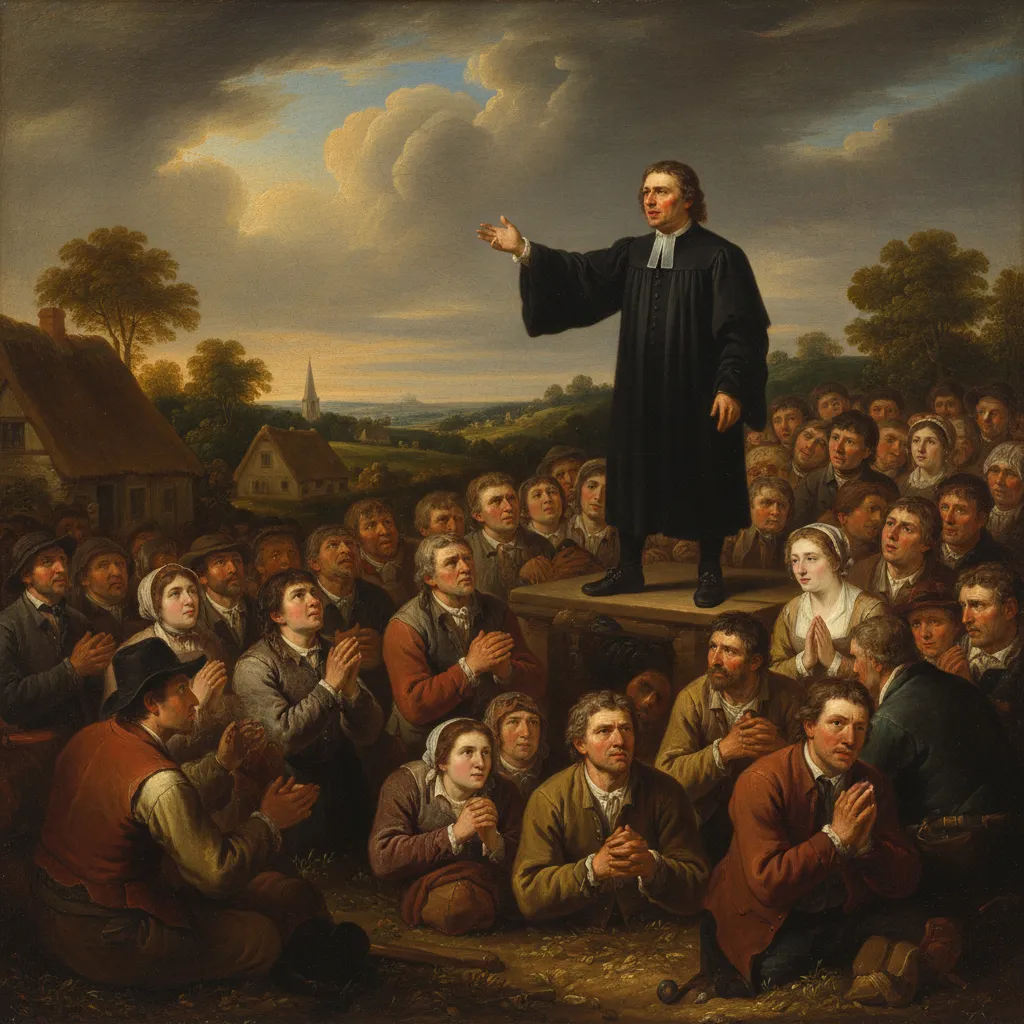
On May 24, 1738, a discouraged Anglican minister named John Wesley reluctantly attended a small group meeting on Aldersgate Street in London. Someone was reading from Martin Luther's preface to the book of Romans. And something happened that would change the course of Christianity. Wesley later wrote: "I felt my heart strangely warmed. I felt I did trust in Christ, Christ alone, for salvation; and an assurance was given me that He had taken away my sins, even mine, and saved me from the law of sin and death."
That warm-hearted experience - deeply personal yet leading immediately to public action - captures the essence of Methodist spirituality. Within weeks, Wesley was preaching in the open air to coal miners. Within years, he had organized thousands into small groups called "classes" and "bands" for mutual accountability and growth. By the time he died in 1791, Methodism had spread across England and America, transforming both individuals and society.
Today, over 80 million Christians worldwide identify with the Methodist and Wesleyan tradition. From the United Methodist Church to the African Methodist Episcopal Church, from Free Methodist to Wesleyan denominations, the movement Wesley started continues to shape how millions approach Scripture - with hearts open to experience, minds engaged in understanding, and hands ready to serve. This is what makes daily Bible study in the Methodist tradition so distinctive.
The Methodist Story: From Oxford to the World
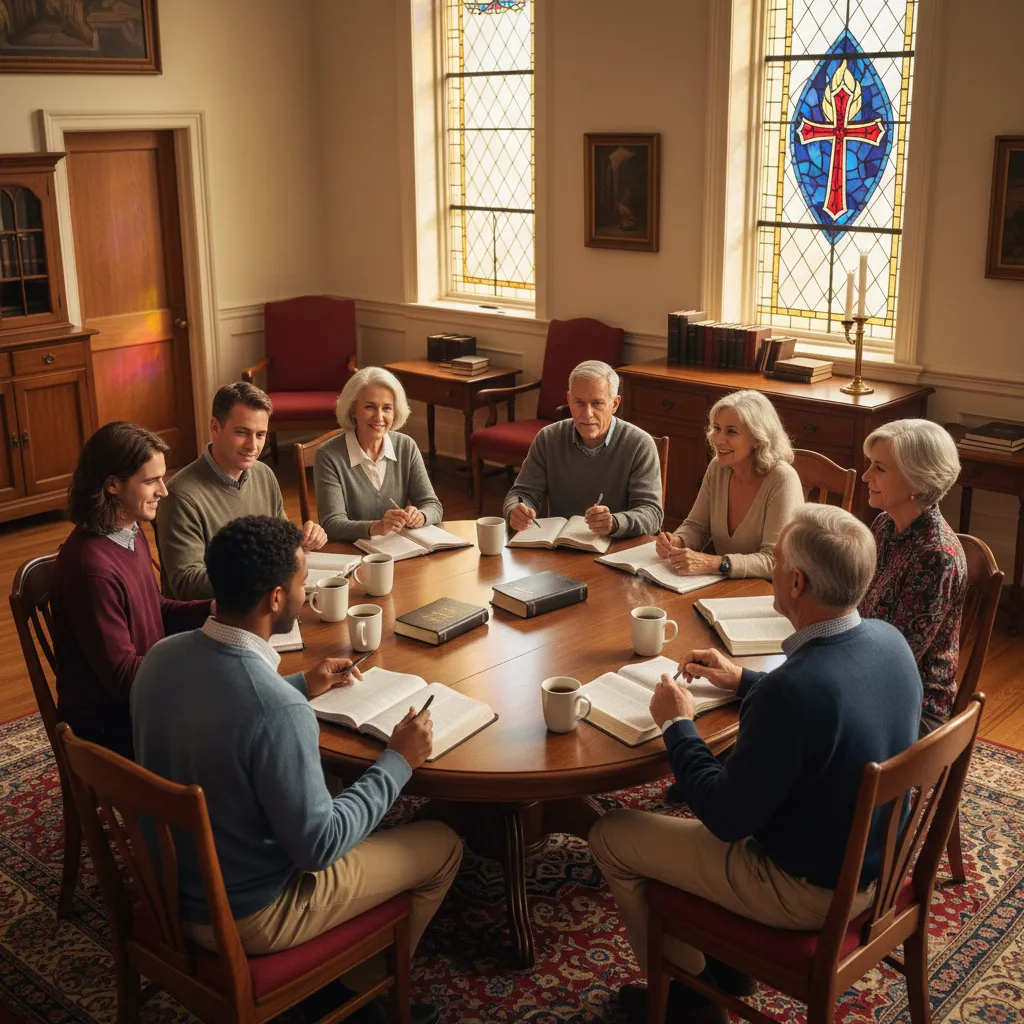
It started as a nickname - and not a kind one. In the late 1720s at Oxford University, a small group of students began meeting regularly for prayer, Bible study, and works of mercy. They visited prisoners, fed the hungry, and tutored poor children. They fasted on Wednesdays and Fridays. They took communion weekly. Their fellow students mocked them as "methodists" because of their methodical approach to the Christian life.
The group's leaders were two brothers: John and Charles Wesley. Both were ordained Anglican priests, sons of a rector, and deeply committed to the Church of England. They weren't trying to start a new denomination - they wanted to renew the existing one. Along with their friend George Whitefield, they formed what they called the "Holy Club," devoted to serious spiritual discipline.
After a disappointing missionary trip to Georgia, John Wesley returned to England in 1738 feeling spiritually empty despite all his religious effort. That's when the Aldersgate experience changed everything. Wesley realized that salvation came not through methodical discipline but through faith - yet discipline remained essential for growing in that faith. The balance of grace and works, of faith and practice, would define Methodist spirituality forever.
What happened next was extraordinary. Wesley began field preaching to crowds too poor and unchurched to enter respectable sanctuaries. He organized converts into small groups - "classes" of about twelve people led by a lay leader, meeting weekly for mutual accountability. He established "bands" for more intensive spiritual direction. He trained lay preachers, published cheap books and pamphlets, and created structures that could function with or without ordained clergy.
By the time of Wesley's death, there were over 72,000 Methodists in Britain and nearly 60,000 in America. The movement crossed the Atlantic with immigrants and exploded during the Second Great Awakening. Circuit-riding preachers carried Methodist faith across the American frontier, establishing churches in virtually every community.
Today, the United Methodist Church is the largest mainline Protestant denomination in the United States, with about 6.3 million members in 30,000 congregations. Globally, Methodist and Wesleyan churches number over 80 million members. The tradition has spawned numerous denominations - AME, AME Zion, CME, Free Methodist, Wesleyan, Church of the Nazarene, and many others - all sharing Wesley's vision of "spreading scriptural holiness across the land."
The Wesleyan Quadrilateral: How Methodists Approach Scripture
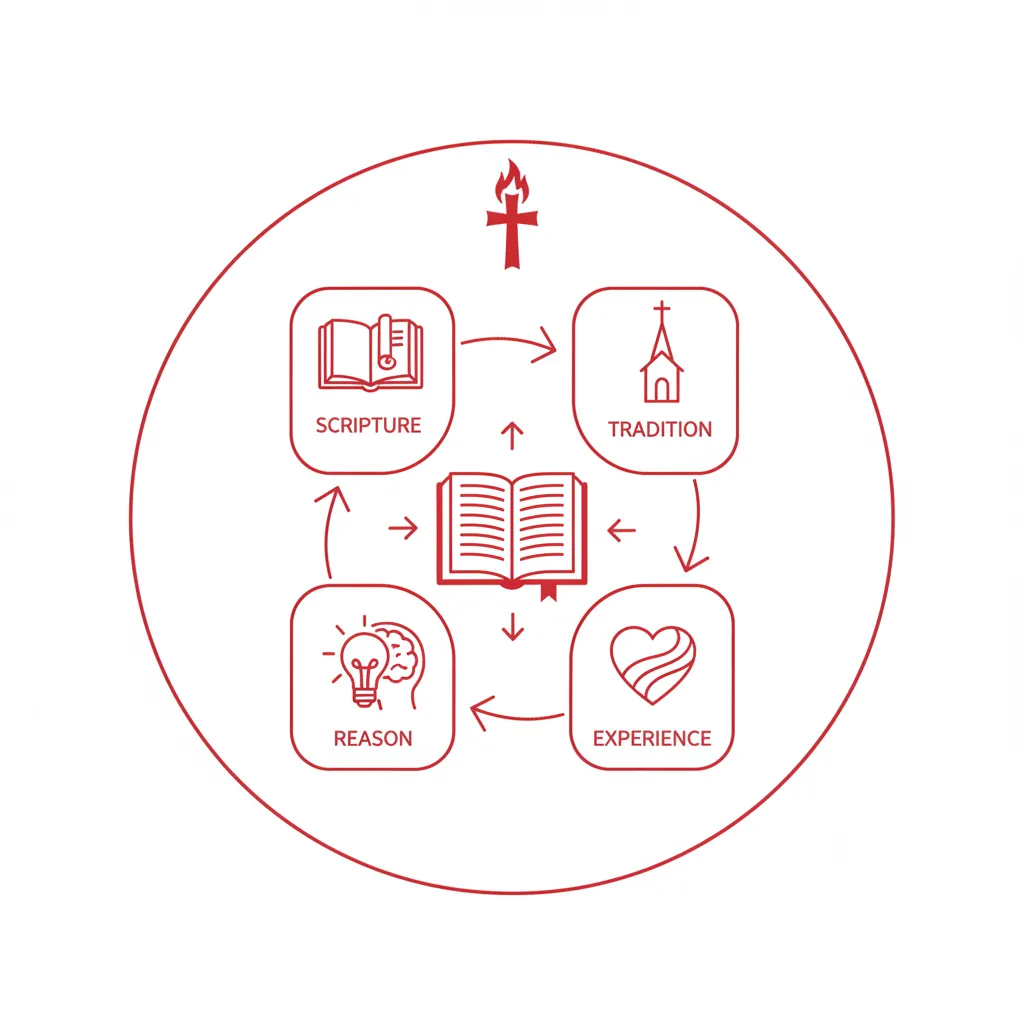
One of Methodism's most distinctive contributions to Christian thought is the "Wesleyan Quadrilateral" - a framework for theological reflection that uses four sources: Scripture, tradition, reason, and experience. While Wesley himself never used this exact term (it was coined by Methodist theologian Albert Outler in the 1960s), it accurately describes how Wesley approached the Bible and theological questions.
1. Scripture: The Primary Source
Wesley called himself "a man of one book" (homo unius libri). Scripture was primary - the foundation upon which everything else stood. He read the Bible in Greek and Hebrew, studied commentaries, and preached systematically through its books. For Wesley, the Bible contained "all that is necessary for salvation" and was the definitive test of any doctrine or practice.
But Wesley didn't read Scripture in isolation. He knew that everyone brings assumptions and perspectives to biblical interpretation. The other three elements of the quadrilateral help ensure faithful reading by providing checks and balances. This differs from some approaches to Baptist Bible study that emphasize sola scriptura more exclusively.
2. Tradition: The Wisdom of the Church
Wesley valued the wisdom accumulated by Christians across centuries. He read the church fathers extensively, drew from Anglican liturgy and devotion, and respected how the church had historically understood Scripture. Tradition doesn't override Scripture, but it helps us read Scripture well. If your interpretation contradicts what Christians have believed for 2,000 years, you should at least pause and reconsider.
3. Reason: God-Given Intelligence
Wesley was a child of the Enlightenment who believed God gave humans rational faculties for a purpose. Faith and reason aren't enemies - they work together. We should use our minds to understand Scripture, identify logical inconsistencies, and apply biblical principles to new situations. "It is a fundamental principle with us," Wesley wrote, "that to renounce reason is to renounce religion."
4. Experience: Personal Encounter with God
Wesley's Aldersgate experience taught him that Christianity isn't just intellectual assent to doctrine - it's personal encounter with the living God. Our experience of God's grace, the inner witness of the Holy Spirit, and the transformation we undergo all inform how we understand Scripture. Experience doesn't create new doctrine, but it confirms and applies what Scripture teaches.
The genius of the Quadrilateral is its balance. Scripture-only approaches can become individualistic and prone to private interpretation. Tradition-only approaches can become rigid and resistant to reform. Reason-only approaches can become dry and disconnected from faith. Experience-only approaches can become subjective and untethered from objective truth. Together, these four elements create a robust framework for faithful Bible study.
Methodist Distinctives: Grace Upon Grace
Ask a Methodist what makes them Methodist, and you'll likely hear about grace. Wesley's theology of grace is perhaps his greatest theological contribution - a sophisticated understanding of how God's unmerited favor works in human salvation and sanctification.
Prevenient Grace: God's First Move
Before we even know God exists, God is at work in us. "Prevenient" means "going before" - this is the grace that precedes conversion, awakening conscience, creating spiritual hunger, and preparing hearts for the gospel. It's why people who have never heard of Jesus can still sense that something more exists. It's why even the most hardened heart can soften. God never gives up on anyone.
This matters for Bible study because it means we approach Scripture expecting God to be already at work. When we read the Bible, we're not introducing God to people - we're helping them recognize the God who has been pursuing them all along.
Justifying Grace: Made Right with God
When someone responds in faith to God's prevenient grace, they receive justifying grace - pardon for sin and restoration of right relationship with God. This is what Wesley experienced at Aldersgate: assurance that Christ had taken away his sins. Justification is by grace through faith, not by works. It's instantaneous, complete, and transformative.
Wesley agreed with Luther and Calvin that we are justified by faith alone. But he insisted that true faith produces works - "faith working through love" as Paul says in Galatians 5:6. A faith that doesn't result in changed living isn't really faith at all. This connects to studying salvation in Scripture.
Sanctifying Grace: Growing in Holiness
Here's where Wesley parts ways with many other Protestant traditions. He believed that God's grace doesn't just pardon us - it transforms us. Sanctification is the ongoing work of the Holy Spirit making us more like Christ. It's a process that continues throughout life, moving us toward what Wesley called "Christian perfection" or "entire sanctification."
Wesley didn't mean sinless perfection - he was realistic about human frailty. He meant perfect love: a heart so filled with love for God and neighbor that sin loses its appeal. While this side of heaven we'll never be complete, we can make genuine progress in holiness. Grace doesn't just cover sin - it conquers it.
"No Holiness But Social Holiness"
Wesley's famous phrase captures Methodism's integration of personal piety and social action. You can't be holy in isolation. True holiness naturally flows into concern for others - feeding the hungry, visiting prisoners, advocating for the oppressed, working for justice. Wesley himself opposed slavery, started schools for poor children, established medical clinics, and organized societies to help the destitute. Personal Bible study must lead to public action.
"Do all the good you can, by all the means you can, in all the ways you can, in all the places you can, at all the times you can, to all the people you can, as long as ever you can."
- John Wesley (attributed)
How Methodist Bible Study Works in Practice
Methodist Bible study has always been deeply communal. From Wesley's original class meetings to today's small groups, the tradition emphasizes studying Scripture together rather than in isolation. This reflects the conviction that faith is lived in community and that we need each other for accountability and growth.
The Class Meeting Model
Wesley's most innovative contribution to church life was the class meeting - small groups of about twelve people meeting weekly for mutual accountability. The format was simple: each person answered the question "How is it with your soul?" Members shared their spiritual struggles and victories, confessed sins, and encouraged one another. A lay leader facilitated but didn't dominate.
While pure class meetings have become rare, their DNA lives on in Methodist small groups. Many UMC churches organize members into "covenant groups" or "accountability partners" that echo Wesley's original vision. The emphasis remains on honest sharing, mutual support, and spiritual growth through community.
Disciple Bible Study
The most distinctive Methodist Bible study curriculum is Disciple Bible Study, published by Cokesbury (the United Methodist publishing house). This intensive 34-week program takes participants through the entire Bible, requiring daily reading, weekly group sessions, and significant commitment. Over three million people have completed Disciple since its launch in 1987.
Disciple reflects Methodist values: it covers the whole canon (not just favorite passages), emphasizes both study and application, requires community participation, and challenges participants to grow in discipleship. Sequels like Disciple II, III, and IV continue the journey through specific biblical themes and books.
The Revised Common Lectionary
Unlike Baptist traditions that often reject lectionaries, United Methodists generally follow the Revised Common Lectionary - a three-year cycle of readings shared with many other denominations (Catholic, Lutheran, Episcopal, Presbyterian). Each Sunday has assigned readings from the Old Testament, Psalms, Epistles, and Gospels.
Using the lectionary has several advantages: it ensures congregations hear the whole Bible over time (not just a pastor's favorites), it connects UMC members with Christians worldwide reading the same texts, and it grounds worship in the church calendar with its rhythm of seasons from Advent through Pentecost.
United Methodist Women and Men's Studies
United Methodist Women (UMW), now United Women in Faith, has provided Bible study resources for Methodist women since 1869. Their annual program involves hundreds of thousands of women studying the same topics across the denomination. Similarly, United Methodist Men's groups often use denominational resources that combine Bible study with service projects and spiritual formation. Both emphasize the connection between studying Scripture and acting on it in the world.
Popular Methodist Bible Study Resources
The Methodist and Wesleyan tradition has produced rich resources for Bible study. Here are some of the most influential:
Cokesbury Resources
Cokesbury is the official publishing house of the United Methodist Church, producing curriculum and resources for all ages:
- Disciple Bible Study - The flagship 34-week whole-Bible intensive
- Short-Term Disciple - Shorter studies on specific books
- Covenant Bible Study - 24-week journey through the biblical story
- Adult Bible Studies - Quarterly lectionary-based curriculum
- The Present Word - Standard quarterly Sunday School lessons
Wesley Study Bible
The Wesley Study Bible (available in NRSV and CEB translations) provides study notes from a Wesleyan theological perspective. It includes explanations of Wesley's views on key passages, articles on Methodist distinctive, and helps for personal and group study in the Wesleyan tradition.
Bible Translations Popular Among Methodists
United Methodists use various translations, though some are more common:
- New Revised Standard Version (NRSV) - Official translation for UMC worship and scholarship
- Common English Bible (CEB) - Modern translation sponsored by United Methodist publishing
- New International Version (NIV) - Popular for readability
- King James Version (KJV) - Wesley's translation, still beloved by many traditional Methodists
Wesley's Own Writings
For those wanting to go deeper into Methodist Bible study, Wesley's own works remain valuable. His Explanatory Notes Upon the New Testament offers verse-by-verse commentary. His sermons (especially the "Standard Sermons") demonstrate how to apply Scripture to life. His journals show faith in action. All are available free online through Wesley Center resources.
Methodist Bible Study Community
Grace-filled community for spiritual growth
What We Offer
- Wesleyan Quadrilateral study approach
- Lectionary-based reading plans
- Small group accountability features
- Integration of study and service
"As a United Methodist Sunday School teacher, I love how Bible Way helps me apply the Wesleyan approach - Scripture, tradition, reason, and experience all working together. My class has grown deeper in their faith."
Sarah M.
Adult Sunday School Teacher, UMC
Frequently Asked Questions
Real questions about Methodist Bible study
What is the Wesleyan Quadrilateral and how does it affect Bible study?
The Wesleyan Quadrilateral is a framework for theological reflection using four sources: Scripture, tradition, reason, and experience. Scripture is primary - it's the foundation and final authority. Tradition helps us understand how Christians throughout history have interpreted Scripture. Reason uses our God-given intelligence to understand and apply biblical texts. Experience confirms Scripture's truth through personal encounter with God. In Methodist Bible study, this means we don't read Scripture in isolation - we consider what the church has taught, think critically about interpretations, and expect personal spiritual encounter. The Quadrilateral creates a balanced approach that avoids both rigid literalism and uncritical subjectivism.
What Bible translation do United Methodists use?
United Methodists don't mandate a single translation, but several are commonly used. The New Revised Standard Version (NRSV) is the official translation for UMC worship, hymnals, and academic work - it's known for scholarly accuracy and inclusive language. The Common English Bible (CEB) is a modern translation sponsored by United Methodist publishing and designed for accessibility. Many individual Methodists also use the NIV for its readability, the KJV for its traditional beauty (Wesley used the KJV), the ESV, or the NASB. The key Methodist principle is that any reliable translation that helps you engage with Scripture is acceptable. Using multiple translations for comparison is actually encouraged in the Wesleyan tradition.
What makes Methodist/Wesleyan theology distinct from Baptist or Reformed traditions?
Several theological distinctives set Methodism apart. First, prevenient grace - Methodists believe God's grace is at work in everyone before conversion, preparing hearts for faith. This makes Methodists generally more optimistic about human cooperation with divine grace than strict Calvinists. Second, Methodists emphasize sanctification as a real process of growing in holiness, not just being declared righteous. Third, social holiness - personal piety must lead to social action. Fourth, the Quadrilateral approach uses tradition, reason, and experience alongside Scripture. Fifth, Methodists typically hold an Arminian view of free will (humans can accept or reject grace) rather than strict predestination. Sixth, United Methodists follow the church calendar and lectionary, unlike many Baptist churches. These differences shape how Methodists read and apply Scripture.
What are Wesley's "means of grace" and how do they relate to Bible study?
John Wesley identified certain practices as "means of grace" - channels through which God's transforming grace flows to believers. These include: instituted means (commanded by Christ) like prayer, Scripture reading, the Lord's Supper, fasting, and Christian fellowship; and prudential means (helpful practices) like class meetings, watching over one another in love, and acts of mercy. Bible study is thus a central means of grace - not just information acquisition but an actual channel of divine transformation. When we read Scripture faithfully, God works through it to convict, comfort, guide, and transform us. This is why Methodists emphasize regular, disciplined Scripture engagement - it's not optional but essential for receiving grace and growing in holiness.
What is Disciple Bible Study and is it worth the commitment?
Disciple Bible Study is the flagship Methodist curriculum, a 34-week intensive program covering the entire Bible. Participants commit to daily reading (about 40 minutes), weekly 2.5-hour group sessions, and significant personal study. Over 3 million people have completed Disciple since 1987. Is it worth it? Participants consistently report it transformed their understanding of Scripture and deepened their faith. The intensity builds discipline, the community creates accountability, and the comprehensiveness ensures you don't just study favorite passages. The full Disciple sequence includes four studies: Disciple I (overview), Disciple II (Into the Word Into the World), Disciple III (Remember Who You Are), and Disciple IV (Under the Tree of Life). Many who complete the sequence describe it as life-changing.
Do United Methodists follow a lectionary?
Yes, the United Methodist Church generally follows the Revised Common Lectionary (RCL), a three-year cycle of Scripture readings shared with many other denominations including Catholic, Lutheran, Episcopal, and Presbyterian churches. Each Sunday has assigned readings from Old Testament, Psalms, Epistles, and Gospels organized around the church calendar (Advent, Christmas, Epiphany, Lent, Easter, Pentecost, Ordinary Time). Following the lectionary ensures congregations hear the whole Bible over time, connects UMC members with the global church reading the same texts, and grounds worship in the ancient rhythm of Christian seasons. Many Methodist Sunday School classes and small groups also use lectionary-based curriculum, studying the passages that will be read in worship that week.
What is "Christian perfection" or "entire sanctification"?
Christian perfection (also called entire sanctification) is Wesley's distinctive doctrine that believers can, by God's grace, reach a state of complete love for God and neighbor. It doesn't mean sinless perfection - Wesley was realistic about human frailty and acknowledged Christians could still make mistakes. Rather, it means a heart so transformed by grace that our fundamental motivation becomes love. We still have temptations, still struggle, still grow - but the root of self-centeredness has been replaced by love. Wesley believed this could happen instantaneously (like a "second blessing") or gradually through sanctification. This doctrine shapes Methodist Bible study by creating expectation for transformation - we don't just learn about Scripture, we expect to be changed by it into more loving people.
What is a Methodist class meeting and can I start one?
Wesley's class meeting was a small group of about 12 people meeting weekly for spiritual accountability. The format was simple: members answered the question "How is it with your soul?" sharing struggles, victories, sins, and growth. A lay leader facilitated but everyone participated. While pure class meetings are rare today, you can start a modern version: gather 8-12 committed people, meet weekly at the same time, use a simple format (opening prayer, Scripture reflection, "How is your soul?" sharing, prayer requests, closing prayer), commit to confidentiality, and emphasize honest sharing over teaching. Many UMC churches have "covenant groups" or "accountability partnerships" that preserve this DNA. The key is mutual vulnerability and genuine concern for each other's spiritual growth.
How does "social holiness" affect Methodist Bible study?
Wesley's principle that "there is no holiness but social holiness" means personal piety must flow into public action. You can't be privately holy while ignoring the suffering around you. This shapes Methodist Bible study in several ways. First, we read with an eye toward application - not just "what does this mean?" but "what should I do?" Second, we pay attention to Scripture's social teachings about justice, poverty, and caring for the vulnerable. Third, our study groups often include service components - studying the Bible together then putting it into practice together. Fourth, we connect individual transformation to societal transformation - changed hearts create changed communities. When Methodists study the Bible faithfully, it leads to feeding the hungry, visiting prisoners, advocating for justice, and working for peace.
What's the difference between United Methodist and other Methodist/Wesleyan denominations?
The Methodist family includes many denominations sharing Wesleyan heritage. The United Methodist Church (UMC) is the largest, formed in 1968 from Methodist Church and Evangelical United Brethren merger - it's theologically moderate to progressive with connectional polity (bishops, conferences). The African Methodist Episcopal (AME), AME Zion, and Christian Methodist Episcopal (CME) churches emerged from Black Methodist communities and maintain strong social justice emphasis. The Free Methodist Church emphasizes holiness, simple lifestyle, and emotional worship. The Wesleyan Church (formerly Pilgrim Holiness) stresses entire sanctification and conservative doctrine. The Church of the Nazarene grew from holiness revival movements. All share Wesley's theology of grace and sanctification but differ on governance, worship style, and specific theological positions. Bible study resources from any Wesleyan tradition generally work for others.
What resources does Cokesbury offer for Methodist Bible study?
Cokesbury is the official United Methodist publishing house, offering extensive Bible study resources. Core curricula include: Disciple Bible Study (34-week whole-Bible intensive), Short-Term Disciple (focused book studies), Covenant Bible Study (24-week biblical narrative), Adult Bible Studies (quarterly lectionary-based lessons), and The Present Word (standard Sunday School curriculum). For specific groups: studies for youth, children, women (United Women in Faith resources), and men. Study Bibles: Wesley Study Bible in NRSV and CEB. Seasonal studies for Advent, Lent, and special occasions. Digital resources through Amplify and MinistryMatters websites. Most Cokesbury resources emphasize Wesleyan theological distinctives, connect study to service, and are designed for group use with discussion questions. Available at cokesbury.com or through local United Methodist churches.
How can I apply Wesleyan principles to personal Bible study?
To study Scripture in the Wesleyan way: First, approach with expectation - expect God to speak through Scripture as a means of grace. Second, use the Quadrilateral: read the text carefully (Scripture), consider how Christians have historically understood it (tradition), think critically about interpretation and application (reason), and remain open to the Spirit's illumination (experience). Third, read for transformation not just information - ask "How should this change me?" Fourth, connect personal study to community - share insights with others, use study groups. Fifth, link study to action - identify concrete ways to apply what you learn. Sixth, maintain regularity - Wesley was methodical, establishing daily patterns of Scripture reading. Seventh, journal your reflections - Wesley kept extensive journals. Eighth, use helps like commentaries and study Bibles while keeping Scripture primary.
Helpful External Resources
Trusted Methodist and Wesleyan Bible study resources
United Methodist Church
Official UMC resources, news, and denominational information
umc.org →Cokesbury
Official UMC publishing house - curriculum and resources
cokesbury.com →Bible Gateway
Multiple translations including NRSV and CEB
biblegateway.com →Got Questions
Biblical answers to faith and doctrine questions
gotquestions.org →Ministry Matters
UMC worship resources and lectionary helps
ministrymatters.com →Wesley Center Online
Wesley's sermons, writings, and Wesleyan resources
wesley.nnu.edu →Blue Letter Bible
Greek/Hebrew tools, commentaries, and lexicons
blueletterbible.org →Vanderbilt Lectionary
Revised Common Lectionary readings and resources
lectionary.library.vanderbilt.edu →Related Bible Studies
New Believers
Foundations of faith
Grace Study
Wesleyan emphasis
Holy Spirit
Sanctifying power
Romans Study
Wesley's Aldersgate text
Explore More Bible Studies
Experience Scripture in the Wesleyan Way
For over 280 years, Methodists have approached the Bible with hearts open to experience, minds engaged in understanding, and hands ready to serve. Join millions who have discovered that grace-filled Bible study transforms not just individuals but entire communities. Start your Wesleyan journey today.