
Personal Peace Practice
Individuals finding calm through daily Scripture meditation and prayer.
Anxiety affects millions of people, and Christians are not immune to its grip. But Scripture offers powerful truth for the anxious soul - not dismissive platitudes, but genuine hope rooted in God's character and promises. A Bible study on anxiety explores what God's Word says about worry, fear, and the supernatural peace available to believers. Whether you struggle with general anxiety, panic attacks, or chronic worry about the future, our comprehensive Bible study resources will guide you toward the peace that surpasses all understanding.
God's peace surpasses understanding and actively guards your heart and mind when you pray instead of worry (Philippians 4:6-7)
Jesus directly addressed worry, teaching us to trust our Heavenly Father who cares for birds and flowers much more than us (Matthew 6:25-34)
We can cast ALL our cares on God because He genuinely cares for us - not some burdens, but every single one (1 Peter 5:7)
Biblical heroes like David, Elijah, and Paul all struggled with anxiety - Scripture honestly portrays their struggles and God's faithful response
God's command "fear not" appears over 365 times in Scripture - one for every day - showing His constant invitation to trust Him
Renewing your mind with Scripture transforms anxiety patterns - we take thoughts captive and make them obedient to Christ (2 Corinthians 10:5)
The Bible doesn't ignore our struggles - it addresses them directly with truth and hope. Explore our comprehensive features designed to help you experience God's peace in the midst of anxiety.
Discover the supernatural peace that God offers - a peace that surpasses understanding and guards your heart and mind in Christ Jesus.
Learn how to take every anxious thought captive through prayer, petition, and thanksgiving as Scripture instructs us to do.
Build unshakeable faith through studying God's faithfulness throughout Scripture and His promises for every anxious situation.
Master the practice of meditating on God's Word day and night, replacing anxious thoughts with divine truth and promises.
Learn the biblical practice of surrendering your worries to God, trusting that He genuinely cares for you and your concerns.
Discover how to anchor your soul in the unchanging truths of Scripture when emotions and circumstances create waves of anxiety.
See how believers are discovering God's peace in the midst of anxiety
Individuals finding calm through daily Scripture meditation and prayer.

Communities studying Scripture together to support those with anxiety.

Learning to bring every anxious thought to God in prayer.

Studying Jesus' teaching about God's care for creation and us.

Capturing anxious thoughts and replacing them with biblical truth.
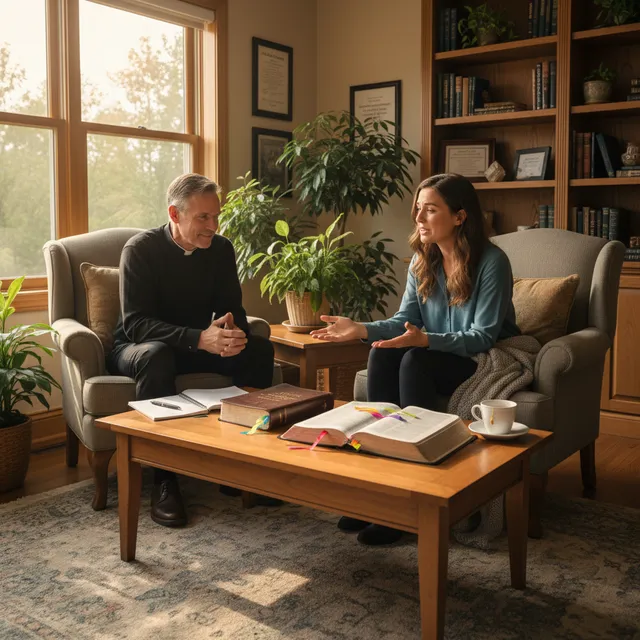
Pastoral care combining Scripture with compassionate support.
Comprehensive biblical studies addressing every aspect of anxiety and worry. Pair with our prayer Bible study for complete spiritual formation.
Key Scripture passages addressing worry, fear, and anxious thoughts
Practical approaches to anxiety found in Scripture
Biblical figures who experienced anxiety and how God helped them
Divine assurances for those struggling with worry and fear
Real testimonials from believers finding peace through Scripture
"For years, I was crippled by panic attacks and constant worry. Bible Way's anxiety study taught me to take every thought captive and replace lies with God's truth. Philippians 4:6-7 became my lifeline. I'm not cured, but I have weapons to fight back now."
"We use this anxiety study in our pastoral counseling ministry. It doesn't dismiss the reality of anxiety disorders but shows how Scripture speaks directly to worry and fear. We've seen real transformation when people combine professional help with biblical truth."
"When our daughter was diagnosed with an anxiety disorder at 15, we didn't know how to help her spiritually. This study gave us Scripture to pray over her, strategies to teach her, and hope that God hasn't forgotten her. She's learning to fight fear with faith."
Everything you need to study what Scripture says about anxiety and peace. Access alongside our online Bible study platform.
Curated collection of Bible verses about peace, trust, and overcoming anxiety for memorization and meditation.
Structured prayers for anxious moments, including Scripture prayers and breath prayers for panic attacks.
Journal template for capturing anxious thoughts and replacing them with corresponding biblical truths.
Verse-by-verse exploration of the Shepherd Psalm with application for anxiety and fear.
30-day devotional journey through Scripture's teachings on peace, trust, and surrendering worry.
Practical exercises to strengthen trust in God through remembering His faithfulness and studying His character.
A Bible study on anxiety reveals that God takes our worries seriously and offers genuine solutions. The cornerstone passage is Philippians 4:6-7: "Do not be anxious about anything, but in everything by prayer and supplication with thanksgiving let your requests be made known to God. And the peace of God, which surpasses all understanding, will guard your hearts and your minds in Christ Jesus." This isn't a dismissive command but an invitation - instead of worrying, we're to bring every concern to God in prayer. The result is supernatural peace that acts as a guard, protecting our hearts and minds. This peace doesn't depend on circumstances changing but on God's unchanging character. Combined with our Psalms Bible study, you'll discover David's raw expressions of anxiety and his path back to peace.
Jesus addressed anxiety directly in Matthew 6:25-34, using nature illustrations to teach trust. "Look at the birds of the air," He said, "they neither sow nor reap nor gather into barns, and yet your heavenly Father feeds them. Are you not of more value than they?" His logic is compelling: if God cares for birds and flowers, how much more does He care for you? The solution Jesus offers isn't denial of real needs but a shift in focus: "Seek first the kingdom of God and his righteousness, and all these things will be added to you." Worry assumes we're in control and God isn't; faith reverses that, acknowledging God's sovereign care. Our faith Bible study explores building this trust more deeply.
Whether you struggle with chronic worry, panic attacks, or general anxiety, Scripture offers real hope. Perfect for women's groups and men's studies.
"I've struggled with anxiety my whole life. Medication helps, but this study gave me spiritual weapons too. Now when panic rises, I have Scripture to speak to it. Philippians 4:8 has become my filter for what thoughts I'll entertain."
Rebecca S.
Mental Health Advocate, Boston
Common questions about anxiety according to Scripture
The Bible addresses anxiety directly and compassionately. Philippians 4:6-7 instructs, "Do not be anxious about anything, but in everything by prayer and supplication with thanksgiving let your requests be made known to God. And the peace of God, which surpasses all understanding, will guard your hearts and your minds in Christ Jesus." This isn't a dismissive command but an invitation to exchange our worries for God's peace. Jesus addressed worry in Matthew 6:25-34, teaching us to trust our Heavenly Father who cares for even the birds and flowers. 1 Peter 5:7 invites us to cast "all your anxieties on him, because he cares for you." The Psalms are filled with honest expressions of anxiety and the path back to peace - David repeatedly moved from distress to declaring God's faithfulness. Scripture acknowledges anxiety as a real human experience while offering supernatural resources to address it.
This is a nuanced question that requires careful biblical thinking. Anxiety as an involuntary emotional response or a medical condition is not itself sin - we don't choose to feel anxious any more than we choose to feel physical pain. Jesus Himself experienced something like anxiety in the Garden of Gethsemane, described as being "sorrowful and troubled" and "in agony" (Matthew 26:37-38, Luke 22:44). Paul openly shared his anxieties for the churches (2 Corinthians 11:28). However, Scripture does call us not to worry in a way that suggests some aspect of chronic worry can become sinful - specifically when it reflects a lack of trust in God's character and promises. The command "do not be anxious" in Philippians 4:6 is paired with the solution of prayer, suggesting the issue is what we do with our anxious thoughts, not their initial occurrence. The sin is not in the feeling but in nurturing worry rather than taking it to God. Our faith Bible study explores this trust dynamic more deeply.
Philippians 4:7 describes "the peace of God, which surpasses all understanding." This is a supernatural peace that doesn't make logical sense given circumstances. It's not peace because your problems are solved, but peace despite ongoing challenges. This peace "surpasses understanding" because it can't be explained by human reasoning - someone should be anxious in that situation, but God's peace guards them. The phrase "will guard your hearts and your minds" uses military language - this peace acts as a sentinel, protecting our inner life from anxiety's assault. This isn't something we manufacture through positive thinking but something God supplies when we pray instead of worry. It's peace rooted not in our circumstances but in God's character, sovereignty, and promises. People experiencing this peace often describe knowing everything isn't okay but feeling a deep settledness that God is in control. This supernatural peace is available to every believer who brings their anxieties to God in prayer.
In Matthew 6:25-34, Jesus provides several strategies for overcoming worry. First, He uses logic: if God provides for birds who don't work, and clothes flowers in splendor, "will he not much more clothe you, O you of little faith?" We're infinitely more valuable to God than birds. Second, He points out worry's futility: "Which of you by being anxious can add a single hour to his span of life?" Worry doesn't accomplish anything positive. Third, He acknowledges that pagans chase after material security, but "your heavenly Father knows that you need them all." God is aware of our needs. Fourth, He redirects our focus: "Seek first the kingdom of God and his righteousness, and all these things will be added to you." The antidote to worry is redirected attention toward God's kingdom. Finally, He limits our concerns: "Do not be anxious about tomorrow... Sufficient for the day is its own trouble." We're called to handle today's challenges, not borrow tomorrow's. These principles, when consistently applied through prayer and Scripture meditation, gradually rewire anxious thought patterns.
1 Peter 5:7 instructs, "casting all your anxieties on him, because he cares for you." The word "casting" (Greek: epirripto) suggests a decisive throwing action - like throwing a net or burden onto something else. It's the same word used when the disciples threw their cloaks on the donkey for Jesus to ride. The image is of transferring the full weight of something from yourself to another. "All your anxieties" - not some, not the small ones while keeping the big ones - all of them. The basis for this casting is "because he cares for you." The God of the universe genuinely cares about what worries you. This isn't a one-time action but a continual practice. When anxiety returns (as it often does), we cast it again. Some believers find it helpful to visualize this - literally imagining placing worries in God's hands, or writing them down as an act of transfer. The practice of casting cares is not denial of problems but acknowledgment that God is better equipped to handle them than we are.
Yes, Scripture is remarkably honest about its heroes' mental and emotional struggles. David expressed profound anxiety throughout the Psalms: "When anxiety was great within me, your consolation brought me joy" (Psalm 94:19). He cried out in fear, despair, and distress - and also recorded God's faithful response. Elijah, after his greatest victory on Mount Carmel, fell into such deep depression and fear that he asked God to take his life (1 Kings 19). God didn't rebuke him but sent an angel with food, let him rest, and then spoke to him. Hannah was so distressed over her childlessness that she wept and couldn't eat, and the priest initially thought she was drunk because of her emotional state (1 Samuel 1). Paul openly acknowledged his anxieties: "Apart from other things, there is the daily pressure on me of my anxiety for all the churches" (2 Corinthians 11:28). Even Jesus, in Gethsemane, was "greatly distressed and troubled," telling His disciples, "My soul is very sorrowful, even to death" (Mark 14:33-34). Scripture presents anxiety as part of the human experience, not as a failure of faith.
In 2 Corinthians 10:5, Paul writes about "taking every thought captive to obey Christ." While the immediate context is about false arguments against Christianity, the principle applies to anxious thoughts. The imagery is military - thoughts are like enemy soldiers that must be captured and made obedient. Rather than letting anxious thoughts run free in our minds, we're to arrest them, examine them, and bring them under Christ's authority. Practically, this looks like: (1) Noticing when anxious thoughts arise rather than being swept along by them, (2) Evaluating those thoughts against Scripture - is this fear rational? Is it true? What does God's Word say?, (3) Replacing lies with truth - if anxiety says "God has abandoned you," you respond with "Never will I leave you; never will I forsake you" (Hebrews 13:5). This isn't magical thinking but a discipline of deliberately choosing which thoughts to entertain. Combined with our Romans Bible study on renewing the mind (Romans 12:2), this practice transforms thought patterns over time.
Prayer helps with anxiety in multiple ways. First, it redirects our attention from problems to the Problem-Solver. When we pray, we're acknowledging God's existence, power, and care. Second, it transfers the burden. Philippians 4:6 tells us to make our requests known to God - prayer is the mechanism for casting our cares on Him (1 Peter 5:7). Third, prayer with thanksgiving (emphasized in Philippians 4:6) shifts our perspective toward gratitude, which research shows reduces anxiety. Fourth, prayer invites God's supernatural peace to guard our hearts and minds (Philippians 4:7). Fifth, articulating our fears to God often reveals their irrationality or exaggeration. Sixth, prayer aligns our will with God's, helping us surrender outcomes to His wisdom rather than demanding our preferred solutions. Prayer doesn't magically eliminate all anxiety, but it positions us to receive God's peace and power. Our prayer Bible study provides comprehensive teaching on developing an effective prayer life that addresses anxiety.
Several passages are particularly helpful for anxiety: Philippians 4:6-7 offers the command not to be anxious with the solution of prayer and the promise of peace. Isaiah 41:10 brings reassurance: "Fear not, for I am with you; be not dismayed, for I am your God; I will strengthen you, I will help you, I will uphold you with my righteous right hand." Psalm 23 paints the picture of God as shepherd who leads us beside still waters and through the valley of the shadow of death. Psalm 46:1 declares, "God is our refuge and strength, a very present help in trouble." Matthew 11:28-30 offers Jesus' invitation: "Come to me, all who labor and are heavy laden, and I will give you rest." Romans 8:28 provides perspective: "All things work together for good for those who love God." Jeremiah 29:11 reveals God's good plans. Joshua 1:9 commands courage because God is with us wherever we go. Many believers find memorizing these verses provides immediate access to truth during anxious moments.
Yes, Christians can responsibly use medication for anxiety. Scripture never condemns medical treatment - in fact, Luke, one of Paul's closest companions and Gospel writers, was a physician. Paul advised Timothy to use wine for his stomach ailments (1 Timothy 5:23), showing openness to medicinal remedies. Anxiety disorders often involve brain chemistry imbalances that medication can address, just as diabetes involves insulin imbalances. Taking medication doesn't represent lack of faith any more than using glasses represents lack of faith for vision problems. God can heal directly, but He often works through medicine and medical professionals. The wisest approach combines appropriate medication (when needed) with spiritual practices: prayer, Scripture meditation, community support, and potentially Christian counseling. Medication alone rarely provides complete relief without addressing spiritual and cognitive dimensions. Similarly, spiritual practices alone may not fully address physiological components of anxiety disorders. The goal is wholeness - addressing the person as body, mind, and spirit. Consult both medical and pastoral wisdom for your specific situation.
This touches on the broader question of why God allows suffering. Several biblical perspectives help: First, anxiety often signals genuine danger that requires action - it's part of our God-given survival instinct. Second, in a fallen world, all systems are broken, including our neurological systems that regulate anxiety. Third, God can use seasons of anxiety to draw us closer to Himself, deepen our prayer life, and increase our dependence on Him. Many believers testify that their closest encounters with God came during periods of intense anxiety. Fourth, struggle produces character - Romans 5:3-4 teaches that suffering produces endurance, endurance produces character, and character produces hope. Fifth, experiencing anxiety enables us to comfort others: "Blessed be the God and Father of our Lord Jesus Christ, the Father of mercies and God of all comfort, who comforts us in all our affliction, so that we may be able to comfort those who are in any affliction, with the comfort with which we ourselves are comforted by God" (2 Corinthians 1:3-4). Your struggle equips you for ministry. God's ultimate answer to anxiety is not its elimination in this life but His presence in the midst of it and perfect peace in eternity.
Supporting someone with anxiety requires wisdom and compassion. First, don't minimize their struggle - anxiety feels very real to those experiencing it. Saying "just trust God more" or "don't worry" can feel dismissive. Second, be present - "weep with those who weep" (Romans 12:15). Sometimes presence matters more than words. Third, listen more than you speak - James 1:19 instructs us to be "quick to hear, slow to speak." Fourth, pray with them and for them regularly. Fifth, gently remind them of Scripture without being preachy - perhaps share a verse that's meaningful to you in similar struggles. Sixth, encourage professional help when appropriate - there's no shame in counseling or medication. Seventh, help with practical needs - anxiety can be paralyzing, and practical help reduces burden. Eighth, check in consistently - don't just respond during crisis but maintain ongoing support. Ninth, share your own struggles to reduce shame - vulnerability invites vulnerability. Tenth, point toward hope without dismissing current pain. Our love Bible study explores how to love those who are suffering.
Additional external resources to deepen your study of biblical peace and anxiety
Comprehensive collection of anxiety and peace verses across Bible translations
biblegateway.com →Biblical answers to common questions about stress, worry, and fear
gotquestions.org →Articles and teaching on anxiety from evangelical scholars
thegospelcoalition.org →Contemporary articles on anxiety, mental health, and faith
christianitytoday.com →Anxiety may be common, but it doesn't have to control your life. A Bible study on anxiety equips you with spiritual weapons that actually work - not positive thinking clichés but the powerful Word of God that transforms minds and guards hearts. Whether you're dealing with chronic worry, panic attacks, or generalized anxiety, Scripture speaks directly to your struggle with compassion and real solutions. Join women, men, couples, and families around the world discovering that the peace that surpasses understanding is not a myth - it's a promise. Download Bible Way today and begin your journey from anxiety to peace.