
Bible Translations Comparison
Choosing the right Bible translation can transform your understanding of Scripture. Whether you prefer the majestic language of the KJV, the readability of the NIV, or the precision of the ESV, Bible Way gives you access to 50+ translations to find the version that speaks to your heart.
💡Key Takeaways: Understanding Bible Translations
No Single "Best" Translation
The best Bible translation depends on your purpose. Use literal translations (ESV, NASB) for study, readable translations (NIV, NLT) for daily reading, and paraphrases (The Message) for fresh perspectives.
Multiple Translations Enrich Study
Comparing different translations reveals nuances in the original languages and provides deeper understanding. Bible Way's parallel reading feature makes comparison easy.
Translation Philosophy Matters
Understanding whether a translation is word-for-word or thought-for-thought helps you know what to expect and how to use it effectively in your study.
All Major Translations Are Reliable
Reputable translations are produced by teams of scholars and go through rigorous review. You can trust any major translation to accurately convey God's Word.
Understanding Bible Translations: A Complete Guide
With over 900 English Bible translations available today, choosing the right version for your spiritual journey can feel overwhelming. Each translation represents years of scholarly work, careful consideration of ancient manuscripts, and decisions about how best to communicate God's eternal Word to modern readers. Understanding the different approaches to Bible translation empowers you to select versions that serve your specific needs—whether for daily devotional reading, in-depth inductive Bible study, or audio listening.
The translation philosophy—how closely a version follows the original language structure versus conveying meaning in natural English—significantly impacts your reading experience. Some translations preserve every nuance of the original Hebrew, Aramaic, and Greek texts, while others prioritize communicating the message in contemporary, accessible language. Both approaches have their place in a robust Bible study practice, which is why many serious students use multiple translations together.
Bible Translation Features in Bible Way
Access multiple translations, compare versions, and study the original languages—all in one free app.
50+ Translations
Access major Bible translations in English and dozens of other languages, from literal to paraphrase.
Parallel Reading
Compare different translations side by side to gain deeper understanding of each passage.
Original Languages
Study the original Hebrew, Greek, and Aramaic texts with word meanings and parsing.
Offline Access
Download your favorite translations for reading anywhere, even without internet.
Audio Bibles
Listen to professional audio recordings of popular Bible translations.
Cross-References
Explore related passages across Scripture with integrated cross-reference tools.
Bible Translation Philosophies Explained
Understanding how Bibles are translated helps you choose the right version for your needs. Here are the main approaches used by translation teams.
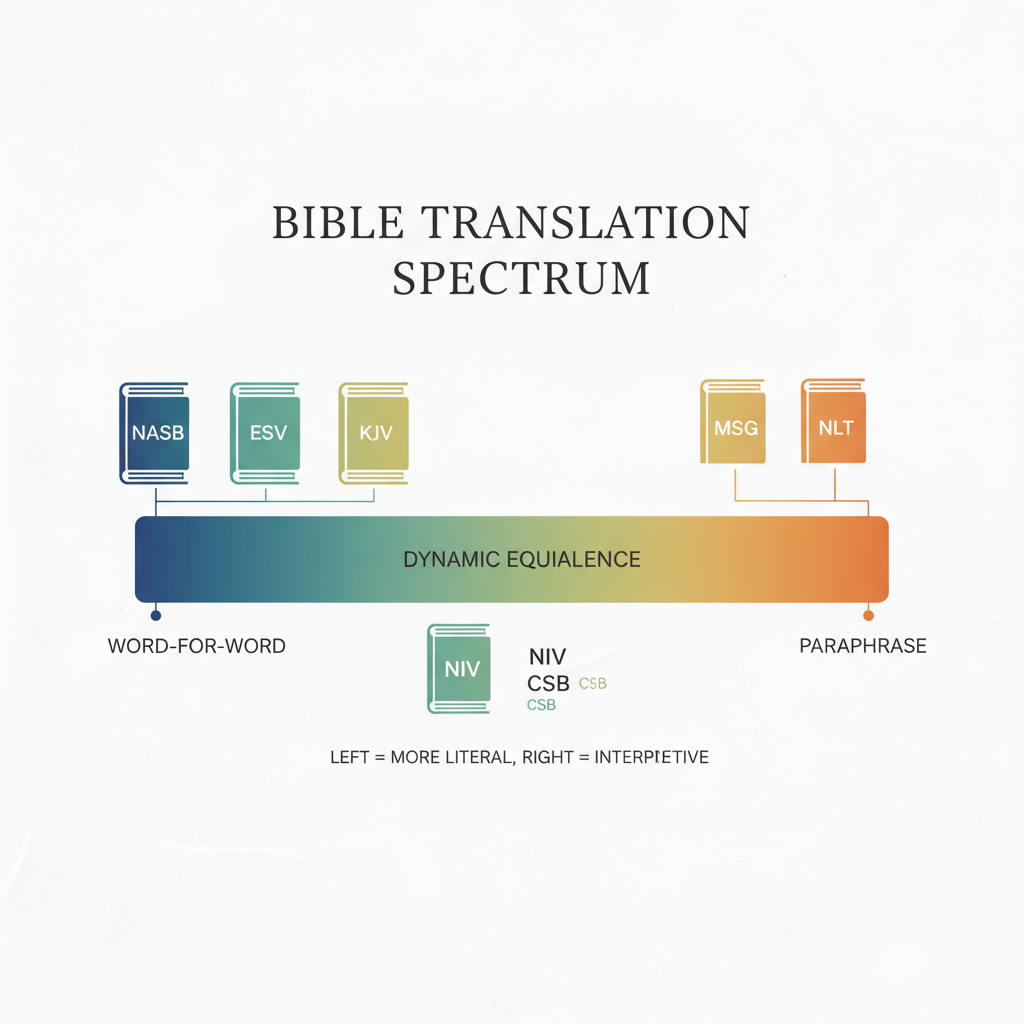
Formal Equivalence (Word-for-Word)
Word-for-word translations aim to match the original Hebrew, Aramaic, and Greek words as closely as possible. This approach preserves the grammatical structure and theological terminology of the original texts. Translations like KJV, NASB, and ESV follow this philosophy.
Strengths
- Precise theological terms
- Good for word studies
- Preserves original structure
Considerations
- Can be harder to read
- May sound unnatural in English
Dynamic Equivalence (Thought-for-Thought)
Thought-for-thought translations focus on conveying the meaning and intent of the original text in natural, modern English. This approach prioritizes clarity and readability while maintaining accuracy to the original message.
Strengths
- Highly readable
- Clear meaning
- Accessible to new readers
Considerations
- Less literal
- Some interpretation involved
Optimal Equivalence (Balanced)
Optimal equivalence seeks the best of both worlds, using word-for-word translation when possible while shifting to thought-for-thought rendering when necessary for clarity. This balanced approach aims for both accuracy and readability.
Strengths
- Best of both approaches
- Versatile for all uses
- Accurate yet readable
Considerations
- Less consistent approach
- Newer methodology
Paraphrase
A paraphrase restates the Bible in contemporary idioms and expressions, capturing the tone and impact of the original rather than literal words. While not a word-for-word translation, paraphrases can bring fresh insights to familiar passages.
Strengths
- Very easy to read
- Fresh perspective
- Captures emotional tone
Considerations
- Not suitable for study
- More interpretive
Popular Bible Translations Compared
Explore the most widely-used Bible translations, understand their unique characteristics, and find the versions that best fit your study style. Bible Way includes all of these translations and more.

King James Version (KJV)
The King James Version, published in 1611, remains one of the most influential English Bible translations in history. Commissioned by King James I of England, it was translated by 47 scholars who worked to create an accurate and majestic rendering of Scripture. The KJV is known for its poetic language, memorable phrasing, and enduring impact on English literature and Christian worship.
Key Features:
- Majestic, poetic language
- Deep theological terminology
- Widely quoted in sermons
- Rich literary tradition
- Public domain (free to use)
New International Version (NIV)
The New International Version is one of the most widely read modern English Bible translations. First published in 1978 and updated in 2011, the NIV balances accuracy with readability using a dynamic equivalence approach. Over 500 million copies have been sold worldwide, making it one of the best-selling Bible translations of all time.
Key Features:
- Modern, clear language
- Balance of accuracy and readability
- Widely used in churches
- Extensive study resources available
- Gender-accurate language

English Standard Version (ESV)
The English Standard Version, published in 2001, is a word-for-word translation that prioritizes accuracy to the original Greek and Hebrew texts while maintaining readability. It has become increasingly popular in Reformed and evangelical churches, as well as in academic settings. The ESV is known for its precision and suitability for serious Bible study.
Key Features:
- Word-for-word accuracy
- Scholarly precision
- Modern language structure
- Popular in seminaries
- Excellent for cross-references
New Living Translation (NLT)
The New Living Translation uses a thought-for-thought translation philosophy to communicate the meaning of Scripture in contemporary, everyday English. First published in 1996, it was created by 90 Bible scholars who translated directly from the original Hebrew, Aramaic, and Greek texts. The NLT excels at making complex biblical concepts accessible to modern readers.
Key Features:
- Highly readable language
- Excellent for new readers
- Clear communication of meaning
- Great for youth ministry
- Smooth narrative flow

New American Standard Bible (NASB)
The New American Standard Bible is considered one of the most literally accurate English translations available. Originally published in 1971 and updated in 2020, the NASB follows a strict word-for-word translation philosophy. It is highly valued by scholars, pastors, and serious students who want to study Scripture as closely as possible to the original languages.
Key Features:
- Most literal modern translation
- Consistent word translation
- Preserves grammatical structure
- Italics for implied words
- Ideal for original language study

New King James Version (NKJV)
The New King James Version, published in 1982, modernizes the language of the classic KJV while preserving its traditional style and formal equivalence approach. It eliminates archaic words like "thee" and "thou" while maintaining the reverent tone that KJV readers appreciate. The NKJV offers an excellent bridge between traditional and modern translations.
Key Features:
- Updated KJV language
- Preserves traditional style
- Based on same manuscripts
- No archaic pronouns
- Familiar yet accessible

The Message
The Message is a contemporary paraphrase of the Bible by Eugene Peterson, a pastor-scholar who spent ten years translating Scripture into everyday American English. Rather than a word-for-word translation, it captures the tone, rhythm, and idioms of the original languages in fresh, modern expressions. The Message is ideal for devotional reading and gaining new perspectives on familiar passages.
Key Features:
- Contemporary language
- Captures original impact
- Fresh perspective on Scripture
- Excellent for devotions
- Engaging narrative style

Christian Standard Bible (CSB)
The Christian Standard Bible, published in 2017, uses an optimal equivalence philosophy that balances word-for-word precision with thought-for-thought clarity. Translated by over 100 scholars from 17 denominations, the CSB aims to be both faithful to the original texts and highly readable. It has quickly gained popularity as a versatile translation for all purposes.
Key Features:
- Balanced translation approach
- Highly readable
- Strong textual accuracy
- Multi-denominational translation
- Modern scholarship
How to Choose the Right Bible Translation
Selecting the right Bible translation depends on how you plan to use it. Consider these factors when making your choice:
For Daily Devotional Reading
Choose a readable translation like the NIV, NLT, or CSB. These balance accuracy with natural English flow, making them ideal for daily devotional time and morning Bible study.
For In-Depth Study
Word-for-word translations like the ESV, NASB, or KJV preserve the original language structure, making them excellent for verse-by-verse study, word studies, and theological analysis.
For New Believers
Begin with highly accessible translations like the NLT or The Message. These communicate Scripture's meaning in everyday language, perfect for new believers building their foundation in God's Word.
For Group Study
Consider what translation your church or online Bible study group uses, or use Bible Way's parallel reading feature to study multiple versions together.

Learn More About Bible Translations
Explore these trusted resources for deeper understanding of Bible translations and their history.
BibleGateway Translation Comparison
Compare any passage across 60+ translations side by side. One of the most comprehensive online Bible resources available.
Visit BibleGateway →Bible Hub Interlinear
Study Scripture word-by-word with the original Hebrew and Greek texts, including Strong's numbers and parsing.
Visit Bible Hub →Got Questions: Bible Translations
Answers to common questions about Bible translations, including accuracy, reliability, and which to choose.
Visit Got Questions →Frequently Asked Questions About Bible Translations
Get answers to the most common questions about choosing and using different Bible versions.
Q:What is the most accurate Bible translation?
The most accurate word-for-word translations are the NASB (New American Standard Bible) and the ESV (English Standard Version). These translations prioritize literal accuracy to the original Hebrew, Aramaic, and Greek texts. However, "accuracy" can also mean accurately conveying meaning, where thought-for-thought translations like the NIV excel. The best approach is to use multiple translations together for comprehensive understanding.
Q:What is the easiest Bible translation to read?
The easiest Bible translations to read are the NLT (New Living Translation) at a 6th-grade reading level and The Message, which uses contemporary everyday language. The NIV is also highly readable at a 7th-8th grade level while maintaining good accuracy. For children and new readers, translations like the NIrV (New International Reader's Version) are specifically designed for accessibility.
Q:What is the difference between KJV and NIV?
The KJV (King James Version) from 1611 uses formal, archaic English ("thee," "thou," "hath") and follows a word-for-word translation philosophy. The NIV (New International Version) uses modern English and balances word-for-word with thought-for-thought translation. The KJV is based on older manuscripts, while the NIV incorporates modern manuscript discoveries. Both are respected translations suitable for different preferences and purposes.
Q:Which Bible translation do most churches use?
The most commonly used Bible translations in churches vary by denomination and tradition. The NIV is the most popular overall, especially in evangelical churches. The ESV has grown significantly in Reformed and conservative evangelical congregations. The KJV and NKJV remain popular in traditional Baptist and Pentecostal churches. Catholic churches often use the NAB (New American Bible) or the NRSV.
Q:How many Bible translations are there?
There are over 900 English Bible translations and paraphrases, ranging from complete Bibles to New Testament only versions. Globally, the Bible has been translated into over 3,500 languages, with complete Bibles available in approximately 700 languages. Bible Way offers access to 50+ translations, including all major English versions and translations in dozens of other languages.
Q:Should I read the Bible in the original language?
Reading the Bible in the original languages (Hebrew, Aramaic, and Greek) can provide deeper insights into word meanings and cultural context. However, quality translations accurately convey God's message, so original language study is optional, not required. Bible Way includes tools for exploring original language words and their meanings, even without learning the full languages.
Q:What is a study Bible vs a regular Bible?
A study Bible includes the biblical text plus extensive notes, cross-references, maps, charts, and commentary to help readers understand context and meaning. A regular Bible contains just the biblical text without additional study helps. Many Bible translations are available in both formats. Bible Way provides study features like commentary, cross-references, and word studies for all translations.
Q:Can I compare Bible translations side by side?
Yes! Comparing Bible translations side by side is an excellent study method that reveals nuances in the original text. Bible Way's parallel reading feature lets you view multiple translations simultaneously, making it easy to see how different versions render the same passage. This is particularly helpful for understanding difficult passages or doing in-depth word studies.
Explore More Bible Study Resources
Bible Reading Plans
Structured plans to read through Scripture in any translation.
Bible Study Guides
In-depth study resources for books of the Bible and topics.
Audio Bible
Listen to professional recordings of popular translations.
Bible Verses
Explore key verses by topic in your favorite translation.
Ready to explore multiple Bible translations?Download Bible Way free today.
Access 50+ translations, compare versions side by side, study original languages, and discover the richness of God's Word like never before.